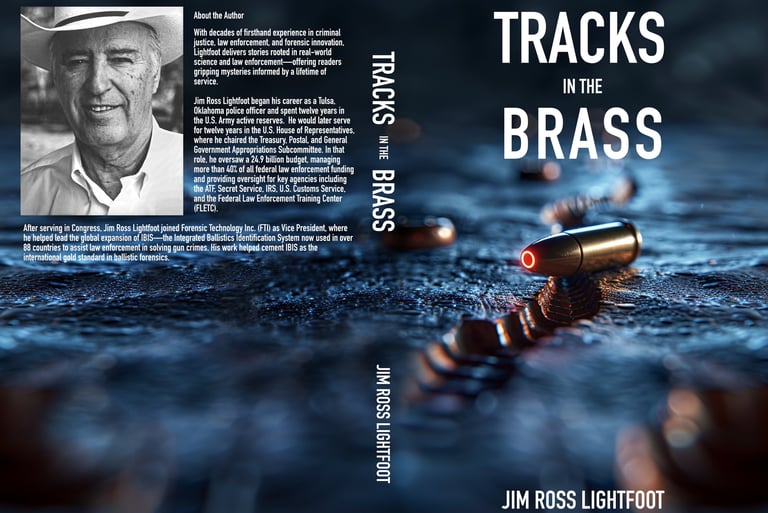
About the Author
Tracks in the Brass, written by one of the best storytellers of our time, unfolds a gripping tale of obsession and unsolved murder. Mixing fiction with reality, this story will keep the reader guessing until the very last chapter. The actions taken by law enforcement are authentic, while the plot is fictional and based on a series of real cases. Tracks in the Brass is educational and entertaining. See if you can find Tracks in the Brass and where they lead.
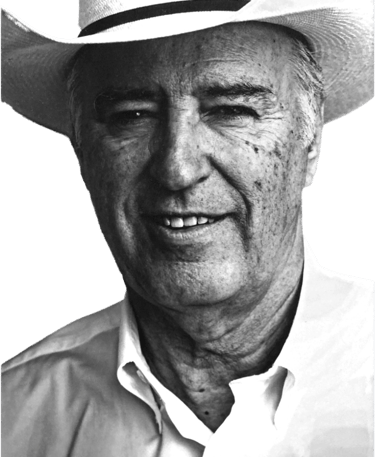
Jim Ross Lightfoot’s first book, Climbing Mountains with God, is a memoir available on jimrosslightfoot.com. His next book, Tracks in the Brass, launches a new series built around the adventures of Detective Roger D. Blair of the Anaheim, California, Police Department.
What makes Tracks in the Brass a little different from most fictional murder mysteries is that the “fictional” stories are rooted in real-life cases—and real-life law enforcement people I know. To keep things honest, I also have a group of seasoned law enforcement officers who proof each book for authenticity, especially police procedures and techniques. Along the way, I sprinkle in a few factual paragraphs about advances in law enforcement technology.
Fair warning: I have a reputation—if you ask me the time of day, I’ll tell you how to build a clock. Now that I’m retired, I’ve decided to build a few clocks on purpose.
And yes—I take the name “Copilot” literally. My pilot logbook shows more than 6,000 hours (many of them instructional), with certificates to fly and instruct in both single- and multi-engine aircraft and to teach instrument flying in each. Aviation was an avocation I loved, and it taught me a lesson I’ve tried to carry into everything else: as George Halas told a young reporter who asked why he worked so hard, “Young man, I have never worked a day in my life. I love what I do.”
This is my first shot at a fictional murder mystery, but I bring some real-life “mileage” to it: I served as a police officer, later had congressional oversight of a large share of federal law enforcement, and then spent 14 years as vice president at Forensic Technology Inc. (FTI)—a company that helped develop the ballistic forensics system that has become the gold standard in more than 88 countries.
For years, ballistics work relied heavily on the comparison microscope (popularized in firearms identification in the late 1920s—famously in 1929, after Chicago’s St. Valentine’s Day Massacre). That attack—widely believed to have been carried out by men connected to Al Capone’s organization against associates of Bugs Moran—made headlines for another reason: the shooters were disguised as police officers, and Dr. Calvin Goddard’s work helped show the guns used were not police-issued weapons. The old method worked, but it was slow and laborious. Later, Robert Walsh—owner of Walsh Engineering—saw how high-speed imaging and pattern-matching could be used to spot flaws in manufactured parts, and that idea was adapted to firearms forensics. Today, that approach is known as IBIS (the Integrated Ballistics Identification System).
Here’s the quick version of how it works: IBIS captures high-resolution images of a bullet or cartridge case, turns those “toolmarks” into digital signatures, and searches them in NIBIN—the National Integrated Ballistic Information Network—managed by ATF. NIBIN currently holds about 7 million pieces of ballistic evidence—and it’s growing all the time—so potential matches can come back fast. The technology has helped crack plenty of cold cases, and that kind of real-world tech (and the history behind it) is the sort of thing I enjoy weaving into a story—right alongside the mystery.
The net result (at least that’s my goal) is a great mystery as you try to figure out the perpetrator, with a bit of law enforcement history mixed in for good measure. So far, everyone who has read Tracks in the Brass has told me they didn’t figure out “who did it” until the surprise ending.
A little about me: I was born in 1938 in Sioux City, Iowa, at the Florence Crittenden Home for Unwed Mothers. I was adopted when I was only a few months old by a farm couple, and I grew up on a farm in southwest Iowa.
After high school, I enlisted in the U.S. Army and served in the Army Reserve from 1956 to 1968.
My business career started as an IBM customer engineer. I soon discovered IBM had a double meaning: in addition to International Business Machines, IBM was also an abbreviation for “I’ve Been Moved.” Move number one was from Omaha, Nebraska, to Tulsa, Oklahoma. After a few years in Tulsa, I was “offered” a transfer to Selma, Alabama. I refused the “offer” and quickly learned that not accepting a transfer “offer” can result in the “offer” being withdrawn—along with the job.
Enjoying my time in Tulsa, I became a police officer. Working the graveyard shift, I noticed a young man walking through a dark neighborhood at about 1:00 a.m. every night. I offered him a ride home; it became a regular event, and I became good friends with my passenger, Milt Haynes.
Milt, along with another gentleman named Jim Hartz, worked at the 50,000-watt powerhouse KRMG Radio in Tulsa. The three of us became great friends and spent a lot of idle time together. One of the big attractions of the day was the Broadway play Camelot, with the original cast of Richard Burton and Elizabeth Taylor. We started a lottery among ourselves, and once we had enough money, we held a drawing to see who would take the money, buy a ticket, go to New York, and see Camelot on Broadway. Jim Hartz was the lucky winner and made the trip.
While in New York, Hartz toured the NBC TV studios and ended up landing a reporter job in Florida. A few years later, he became a host on The Today Show. He and Milt were both hired by national networks. I stayed in America, while Milt joined CBS and ended up in Rhodesia before the country’s name changed to Zimbabwe. That friendship sparked my strong interest in broadcasting.
I later returned to my home region of Shenandoah, Iowa, where I found work at another old-line station, KMA Radio. The station went on the air in 1925 and still operates today. I became a household name at KMA, where I spent 19 years as an award-winning farm broadcaster, speaker, and rodeo announcer.
In 1984, I successfully ran for a seat in the U.S. Congress. During my 12-year tenure, I focused on agriculture and the infrastructure—highways, airports, and waterways—that helps ship farm products overseas. As chairman of the Treasury, Postal, and General Government Appropriations Subcommittee, I oversaw a $24.898 billion budget, including more than 40% of the federal law enforcement budget. This encompassed the Bureau of Alcohol, Tobacco, Firearms, and Explosives (ATF), the United States Secret Service (USSS), the Federal Law Enforcement Training Center (FLETC), the U.S. Customs Service, the IRS, and other agencies within the Treasury Department.
After serving 12 years, I retired from Congress, firmly believing in term limits. I later served as vice president of Forensic Technology Inc. (FTI), a company that helped develop the ballistic forensics system that has become the global standard and is now used in more than 88 countries. I served in that role for 14 years before retiring again. My wife, Nancy, and I live in White Oak, in the Piney Woods of East Texas. I’m currently about halfway through the next Detective Roger D. Blair mystery, Silenced Evil—so if you like a whodunit with real-world law enforcement grit, start with Tracks in the Brass and stay tuned.